
The World’s Most Impressive Tunnel Projects
The World’s Most Impressive Tunnel Projects
Introduction
Tunnels are among the most remarkable achievements in modern engineering. By passing beneath mountains, rivers, seas, and densely populated urban areas, these underground structures overcome geographical barriers and transform transportation, trade, and infrastructure. From high-speed railway connections between countries to underwater road tunnels and massive mountain passages, the world’s most impressive tunnel projects demonstrate how engineering innovation can reshape the way people and goods move.
Throughout history, tunnel construction has evolved from basic excavation techniques into a sophisticated discipline involving advanced drilling machines, geological modeling, automated monitoring, and complex ventilation systems. Today, major tunnel projects play a crucial role in international logistics, urban development, and economic connectivity.
This article explores some of the world’s most impressive tunnel projects, the technologies behind their construction, and their influence on modern infrastructure and global trade.
1. The Channel Tunnel: Connecting Britain and France
The Channel Tunnel, commonly known as the Chunnel, is one of the most famous underground infrastructure projects in the world. Opened in 1994, it connects the United Kingdom and France beneath the English Channel.
The tunnel consists of three parallel passages: two railway tunnels and a smaller service tunnel. Its total length is approximately 50.5 kilometers, including around 37.9 kilometers beneath the sea.
The project transformed transportation between Britain and continental Europe by enabling passenger services and freight transport through a fixed rail connection.
Its major advantages include:
-
Faster cross-border transportation
-
Improved international logistics
-
Reduced dependence on ferry services for rail passengers and freight
-
Stronger economic connections between the United Kingdom and mainland Europe
The Channel Tunnel remains a landmark achievement in underwater tunnel engineering and international transportation infrastructure.
2. The Gotthard Base Tunnel: A Railway Through the Alps
Switzerland’s Gotthard Base Tunnel is one of the most impressive railway engineering projects ever completed. Officially opened in 2016, it extends approximately 57.1 kilometers beneath the Swiss Alps, making it the world’s longest railway tunnel.
The tunnel was designed to improve north-south transportation across the Alps while reducing the challenges associated with steep mountain routes.
Its engineering achievements include:
-
Extensive underground excavation
-
Advanced geological surveying
-
Sophisticated safety and ventilation systems
-
High-capacity railway infrastructure
The Gotthard Base Tunnel has strengthened connections between northern and southern Europe and supports the movement of freight by rail. By making rail transport more competitive with road transportation, the project also contributes to efforts to reduce congestion and transport-related emissions.
3. The Seikan Tunnel: Japan’s Undersea Engineering Marvel
Japan’s Seikan Tunnel connects the islands of Honshu and Hokkaido beneath the Tsugaru Strait. Opened in 1988, it is approximately 53.9 kilometers long, with around 23.3 kilometers running beneath the seabed.
Constructing a tunnel beneath a seismically active maritime region presented substantial challenges, including difficult geological conditions and the risk of water ingress.
Engineers had to develop specialized excavation, waterproofing, and monitoring techniques to make the project possible.
The Seikan Tunnel provides an important railway connection between the two Japanese islands and demonstrates how large-scale underground infrastructure can overcome difficult natural barriers.
Although newer projects have surpassed it in some categories, the Seikan Tunnel remains a milestone in undersea railway engineering.
4. The Lærdal Tunnel: A Breakthrough in Road Tunnel Design
Located in Norway, the Lærdal Tunnel is approximately 24.5 kilometers long and is widely recognized as the world’s longest road tunnel.
Opened in 2000, it connects areas between Lærdal and Aurland, improving road transportation through Norway’s mountainous landscape.
Long road tunnels create challenges beyond excavation, particularly regarding driver concentration, lighting, air quality, and emergency evacuation.
To address these issues, the Lærdal Tunnel includes specially designed illuminated sections and large underground caverns that provide visual variation during the journey.
Its design demonstrates that successful tunnel engineering requires more than structural strength: human factors, safety, and the driving experience must also be considered.
5. The Gotthard Road Tunnel: A Vital European Transport Route
Another major Swiss infrastructure achievement is the Gotthard Road Tunnel, which opened in 1980.
Extending approximately 16.9 kilometers, it provides a key road connection through the Alps and forms part of an important north-south transportation corridor.
The tunnel has supported passenger travel and commercial road transport across Switzerland for decades.
Its importance also highlights the challenges associated with operating major tunnels over long periods. Traffic management, ventilation, emergency response, and maintenance are essential to keeping such infrastructure safe and reliable.
The Gotthard Road Tunnel illustrates how a single infrastructure project can influence regional mobility, logistics planning, and economic activity.
6. The Marmaray Tunnel: Connecting Europe and Asia
Istanbul’s Marmaray project is a major railway infrastructure development that connects the European and Asian sides of the city beneath the Bosporus Strait.
The immersed-tube tunnel section beneath the strait is approximately 1.4 kilometers long, while the wider Marmaray railway system extends across a much longer route.
Opened for passenger services in 2013, the project created a continuous rail connection across a major geographical divide.
Its construction involved demanding engineering conditions, including underwater work, seismic considerations, and the challenges of building within one of the world’s busiest metropolitan areas.
Marmaray demonstrates how tunnel infrastructure can improve urban mobility, integrate railway networks, and strengthen connections between regions and continents.
7. The Future of Tunnel Construction Technology
The next generation of tunnel projects will depend increasingly on advanced technologies and sustainable engineering practices.
Several developments are transforming the industry.
Tunnel Boring Machines
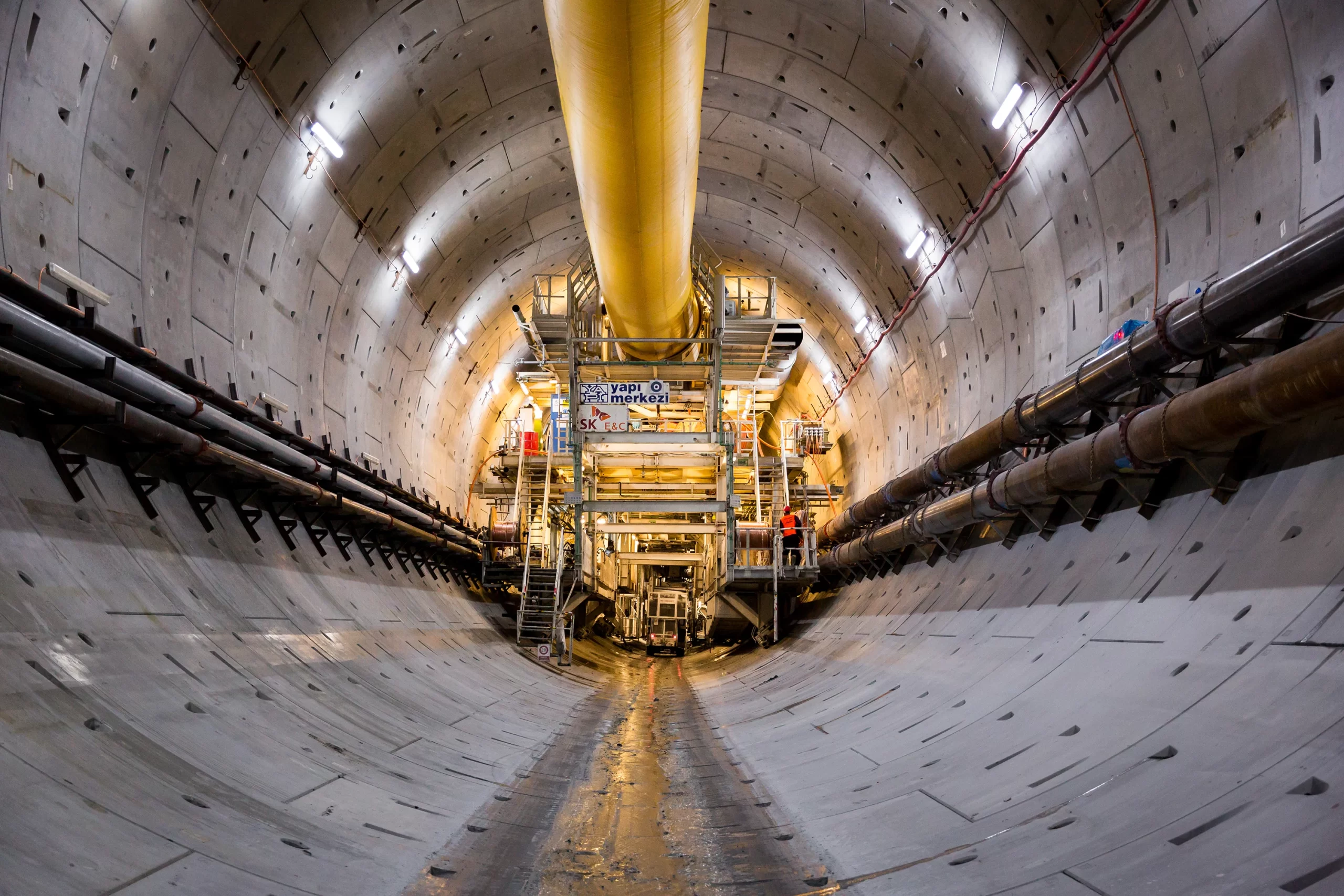
Modern tunnel boring machines (TBMs) can excavate through different geological formations while installing support systems as construction progresses. These machines improve excavation efficiency and help manage risks in challenging environments.
Digital Engineering and Automation
Digital geological models, remote monitoring, robotics, and automated control systems help engineers assess ground conditions, track structural performance, and improve construction planning.
Sustainable Infrastructure
Future tunnel projects are increasingly expected to reduce environmental impacts, improve energy efficiency, and support lower-emission transportation systems.
Safety and Emergency Management
Advanced fire detection, ventilation, communication, and evacuation technologies are essential for protecting passengers, workers, and freight operations.
As these technologies develop, tunnel construction is likely to become more precise, efficient, and adaptable to complex infrastructure requirements.
8. Why Tunnel Projects Matter to Global Trade
Major tunnels are not simply engineering achievements; they are important economic assets.
By reducing travel distances, bypassing geographical obstacles, and connecting transport networks, tunnels can improve the movement of goods and people.
Their economic benefits may include:
-
Lower transportation times
-
More reliable freight routes
-
Improved access to regional markets
-
Greater integration of railway and road networks
-
Increased opportunities for cross-border commerce
For exporters, manufacturers, and logistics providers, efficient transportation infrastructure can improve delivery planning and supply chain performance.
However, the overall impact of a tunnel depends on its connection to ports, railways, highways, customs facilities, and distribution centers. A tunnel delivers the greatest economic value when it forms part of a well-integrated transport network.
Conclusion
The world’s most impressive tunnel projects demonstrate the extraordinary potential of engineering to overcome natural barriers and connect communities, markets, and countries. From the Channel Tunnel beneath the English Channel to Switzerland’s Gotthard Base Tunnel, Japan’s Seikan Tunnel, and Istanbul’s Marmaray connection, these projects have transformed transportation and established new standards for underground construction.
As tunnel boring technology, digital engineering, and sustainable infrastructure practices continue to advance, future projects will push the boundaries of what engineers can achieve. Beyond their technical complexity, these structures play an essential role in economic development, international logistics, and global connectivity.
The story of tunnel engineering is ultimately a story of human innovation: building beneath the obstacles of the natural world to create new possibilities above ground.
